

Eric Peterson is a racer’s racer. Now, he’s governing the Xfinity Series field, replacing the legendary Wayne Auton as the series director.
While growing up on the outskirts of Rockford, Illinois – the same town as seven-time Cup Series championship-winning crew chief Chad Knaus – Peterson hopped in a go-kart at the age of 14. He won the 2000 super late model championship at Madison International Speedway before he stopped racing after 10 years. His parents, who were both teachers, ran out of funding to support his hobby. He made the transition over to working on vehicles.
With guidance from his brother, Peterson jumped at the opportunity to relocate to the NASCAR bubble in Charlotte. While spending two weeks in Charlotte, he recalls dropping off his resume at almost every race team’s shop. At the end of 2006, he accepted a gig from then-Roush Racing.
“I didn’t want to work on cars anymore, so I took a job on the business competition side at Roush,” Peterson recalled in an interview with Jayski.
When Roush kickstarted its ARCA program, it named Peterson as the manager. That was his breakthrough to the competition side. He remained there for 12 years, spending the final eight seasons as the team manager for its Xfinity Series program, which included three driver championships with Ricky Stenhouse Jr. and Chris Buescher.
Peterson served in multiple roles at Roush. At the non-companioned races, he was a spotter, an experience that included a victory with Buescher in 2015 at Iowa Speedway. Ultimately, he played a pivotal role in launching the careers of multiple current Cup Series drivers, including Stenhouse, Buescher and Bubba Wallace.
“Eric was influential in helping me find my way and figuring out how to start building and growing as a race car driver on this side of things and establishing my place,” Buescher said. “We weren’t in the best place as an organization across the board. Our Xfinity stuff was still pretty competitive a lot of times, and we got to have some fun and win a handful of races.”
At the conclusion of 2018, Roush opted to shutter its Xfinity program. Peterson had the option to join another team, but sponsorship fizzled out. Instead, an opening at NASCAR as the Xfinity Series technical director opened up and he put his name into the hat.
The decision was a no-brainer for Peterson.
“I felt like the NASCAR [role] had a longer term upside and I was interested in seeing the other side of the sport,” Peterson added. “That has been interesting. There is way more to it than I expected for sure or even realized on the competition side.”
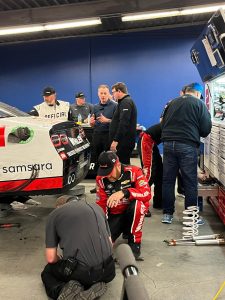
One of the key details that stuck out to Peterson was the small percentage of NASCAR employees that managed the competition side of the series. As the technical director, his primary responsibility was to manage the group of inspectors who oversee the race cars and rule generation. He worked with Auton to help diminish team costs to make the series stronger as a whole.
With Auton’s retirement at the end of 2024, it was a natural progression for Peterson to take over as series director. The duo worked hand-in-hand last year to set Peterson up for natural success as he learned the nuances of the gig. The biggest difference happens during the races, as he’s now actively involved in officiating the event.
“We have a race director that puts the caution out and is kind of the quarterback of the race,” Peterson said. “The series director is the next person in line for making decisions and communicating with the teams and making calls on what we’re going to do or not going to do as far as officiating the race.
“It’s a lot closer to spotting or being actively involved in the competition of the event.”
Given Peterson’s experience on the other side, having existing relationships with team managers is helpful. But when he has to lay down the law, he’s in a confined position.
“If you have a built-up relationship with that type of stuff, it makes it easier for when you have to do something that might not be comfortable for them,” Peterson said. “Go back, that was business, something we had to do and two days later.”
The toughest decisions in 2025 have been issuing Sammy Smith a 50-point penalty and $25,000 fine for wrecking Taylor Gray on the final lap of the spring race at Martinsville Speedway. Three weeks later, Smith was the beneficiary of Jesse Love being disqualified at Rockingham Speedway. The most impactful penalty was delivered to Austin Hill for tagging Aric Almirola at Indianapolis Motor Speedway in July, resulting in a one-race suspension and the loss of all playoff points.
Those were all necessities when serving as the series director.
Peterson added: “I don’t think any of those were surprises or things we’ve never seen before, but it was all first time in those instances of having to make those decisions was not super easy.”
Competitors have noticed Peterson’s diligence of commanding the series. Defending series champion Justin Allgaier believes he’s done a splendid job.
“Eric has done a good job of taking the reins but making it his own,” Allgaier noted. “When you’re in that role, it’s very personal because you have to rule the series and keep the sport in check. One series can affect the whole sport, so you’ve got to rule and keep that in check. You also have to be one-on-one with all these teams, crew chiefs, drivers, team members. Your mentality and persona can affect how the garage either feels or doesn’t feel.”
The paramount concern for Peterson in his position is to continue to find ways to lower costs for teams. He’s aware of the epic-style of racing the series delivers, but wants to make it more manageable so there are more competitive front-running cars.
“If we have the rules as such, the more money you spend the faster you go, the harder it is for the series to be competitive and healthy over a long period of time,” Peterson said. “If we can make it to where you’re cost-capped on certain things, at least from a performance gain, you’re not going to see the result for the spend. I think that makes the series healthier, the racing healthier and more competitive and allows more teams to enter the sport and be successful.”
Peterson has enjoyed the transition to becoming the series director. The 2025 season has largely been dominated by JR Motorsports, with six of JRM’s drivers combining to win 17 of the opening 31 races. With 13 drivers having visited Victory Lane this year, ideally, the series would have more victors.
“We want to have more different winners and try to have that spread out as much as we can, so that’s not ideal,” Peterson said. “[Connor Zilisch] is a generational talent and he’s showing it really quickly here. We’ve had people like that in our sport and you have to appreciate that. At the same token, we don’t really want that but you have to appreciate it as well.”
Filling Peterson’s role as technical director is longtime Xfinity Series crew chief Jason Burdett. Having another set of eyes that was previously on the competition side has helped his transition and turn his attention to details that he didn’t have as much experience at.