
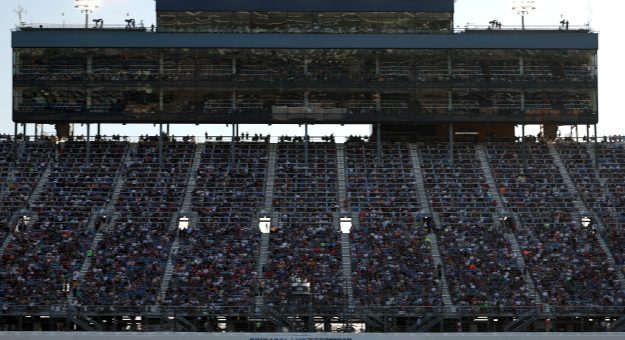
NASCAR, you have a problem—not that it’s a bad problem to have.
In the return to Chicagoland Speedway on Saturday and Sunday, the on-track racing product was everything competitors and fans could have hoped for.
Asphalt that had aged for seven years since NASCAR’s last race in Joliet provided multiple racing lanes, from the bottom of the track to the outside wall.
Tires mattered, especially toward the end of extended green-flag runs.
Both the NASCAR O’Reilly Series race on Saturday and the marquee NASCAR Cup Series event on Sunday offered suspense right up until the checkered flag. In Saturday’s Cuervo 300, Brandon Jones battled Chase Elliott to the finish, winning with an expertly crafted restart in overtime.
In Sunday’s eero 400, Chase Briscoe fended off the dogged pursuit of Joe Gibbs Racing teammate Christopher Bell, winning the race by a fourth of a second.
“So excited to be back in Chicagoland,” Briscoe said soon after climbing from his car. “Hopefully, we can be back.”
True to form, NASCAR’s Gen 7 car excelled on the 1.5-mile intermediate speedway, and Briscoe, an Indiana native, claimed the first victory of his career on that sort of track.
“It’s really cool to win at a mile-and-a-half in the Cup Series,” Briscoe elaborated in his post-race press conference. “I feel like that’s the staple of what the Cup Series is. My teammates have obviously been unbelievable on the mile-and-a-half.
“To do it here at Chicagoland is really special. It is in the Midwest. It’s close to home. Yeah, this has been a place that I’ve always loved coming to back when we used to. I missed it. It’s always been one of my top five tracks.”
If drivers were polled, it’s a given that a strong majority would favor a return to Chicagoland next year, simply based on the nature of the racing.
But there’s the rub. Negotiations between NASCAR and the city of Chicago have advanced to the point where the return of the Chicago Street Race—on hold this season after a three-year run—is a real possibility.
Where Chicagoland Speedway is apt to draw traditional race fans, the Street Race already has a proven track record of exposing a new constituency to stock car racing.
NASCAR’s broadcast rights deal with streaming service Amazon Prime Video may necessitate the inclusion of a marquee event such as the Chicago Street Race—as was the case with the Mexico City race in 2025 and the Naval Base Coronado Street Race this year.
Where the advent of Kansas Speedway has revitalized Wyandotte County with a casino, a massive shopping center, hotels, restaurants and a soccer stadium, Chicagoland Speedway is surrounded by 600,000-square-foot warehouses. No doubt developers of those facilities look at the Joliet race track with covetous eyes.
Would NASCAR consider two races in the Chicago area? It’s an important market, to be sure, but that’s a question that will only be answered with the composition of the 2027 schedule.
One thing is certain. If the Chicago Street Race returns, it won’t be on July 4 weekend. Negotiations so far reportedly have pointed to an earlier date without the complications of a major holiday.
The July 4 weekend also has been mentioned as a possibility for a return to Naval Base Coronado. Given the success of this year’s inaugural event, NASCAR Chief Operating Officer Ben Kennedy expressed the desire to return there, if the United States Navy remains receptive and supportive.
A July 4 date in San Diego would all but guarantee ideal weather for a race.
But would NASCAR consider including two street races in the same season? Is alternating between Chicagoland Speedway and the Chicago Street Race from year to year a possibility?
Those are all choices that will have to be made in the very near future.
Fortunately for the sport, there aren’t any bad choices in the mix.
— NASCAR News Wire —